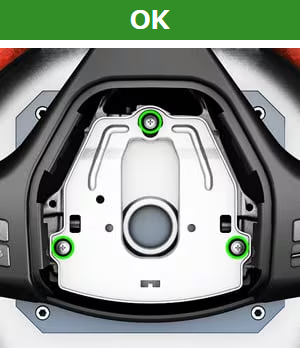
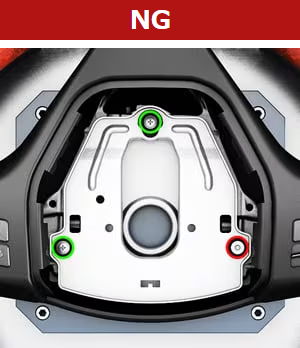
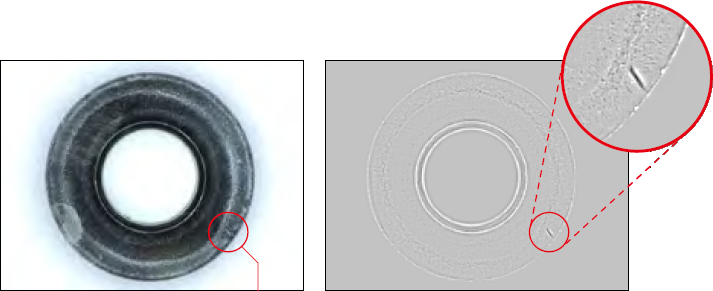
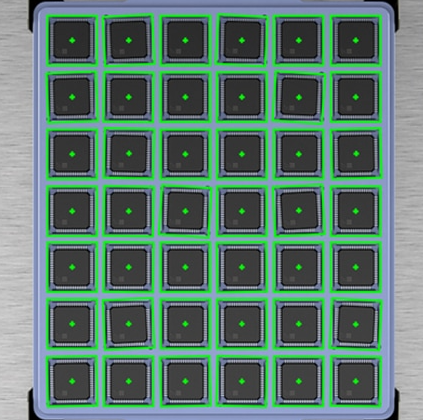
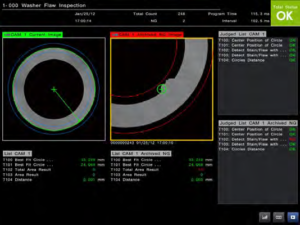
Are all components present and in the correct position? Are the screws tightened? These and other factors must be checked in both manually and automatically assembled products. During inspections, cameras eliminate the human factor and detect errors with a level of repeatable accuracy and speed that the human eye cannot match.
It is often necessary to inspect the surface quality of inspected items. Typical defects include color spots, discoloration, cracks, scratches, and others. Cameras, combined with smart lighting and image processing algorithms, are capable of detecting even defects that are invisible to the human eye.
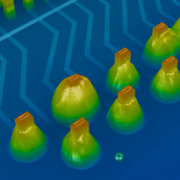
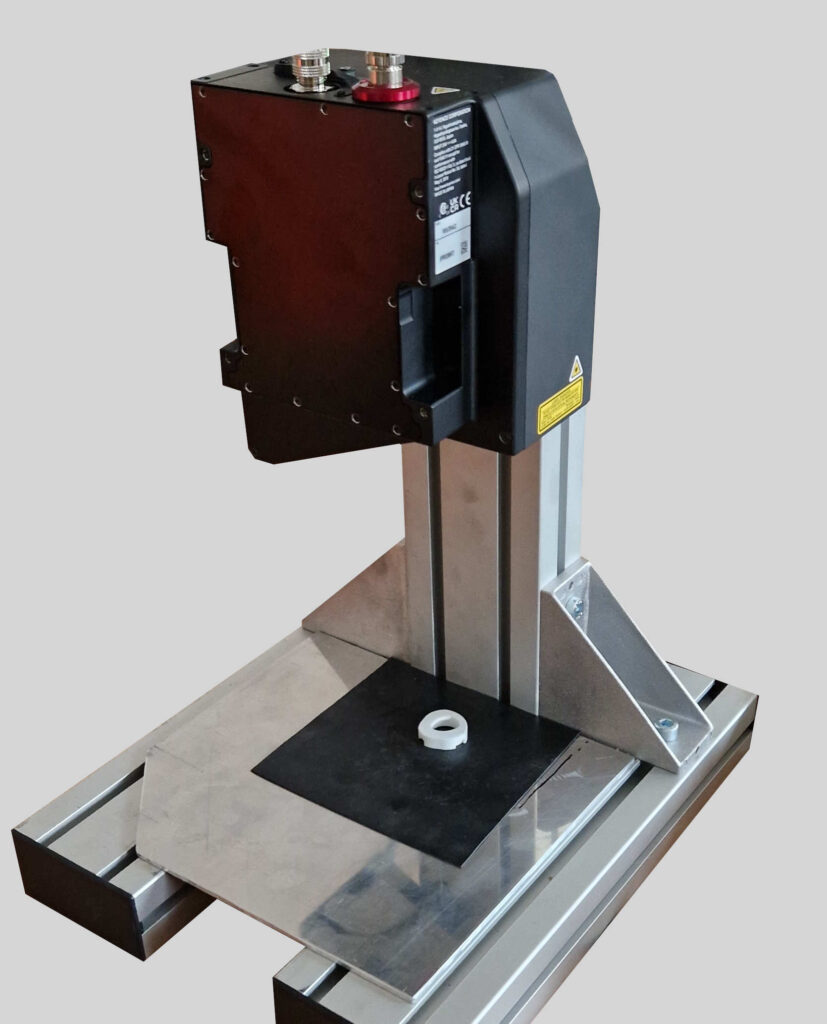
Checking the geometric properties of products is a typical example of the use of camera inspection in manufacturing facilities. Laser 3D scanners can also be used to measure and evaluate volumetric parameters. To assess long-term production quality, it is important to record and analyze the data.
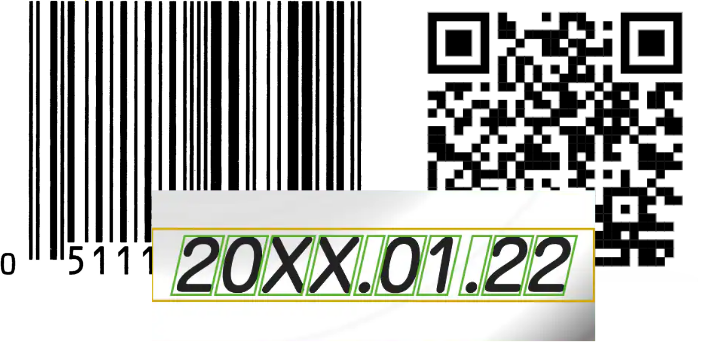
Reading text, barcodes, and 2D codes wherever product identification or readability checks are required. Laser marking of products and subsequent tracking of the production flow using 2D codes is standard practice in modern manufacturing.
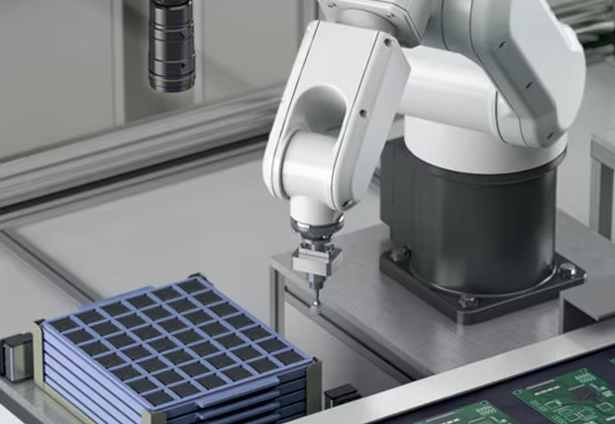
The combination of cameras and robots is ideal for applications where the material being handled may be in various positions or orientations. Because the robot knows exactly where the part is located, it can grasp and place it consistently every time. The camera can also be mounted on a robotic arm, allowing it to inspect the part from multiple angles using a single camera.
Let’s walk through the entire process together. Based on your goals, timeline, and budget, we’ll design a solution tailored to your needs.
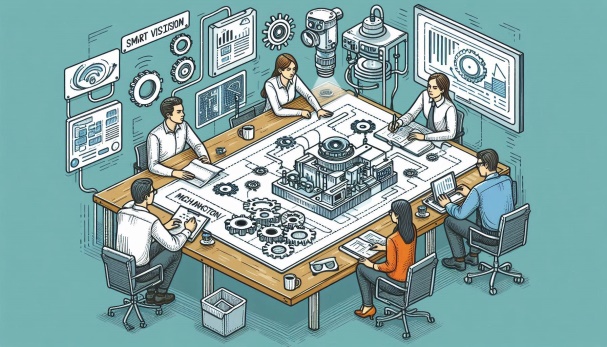
Machine vision is the interplay of appropriate lighting, cameras, lenses, and software that analyzes the image. That is why every application deserves its own development and testing. At our testing center, we can find the right combination of hardware and software solutions for your application.
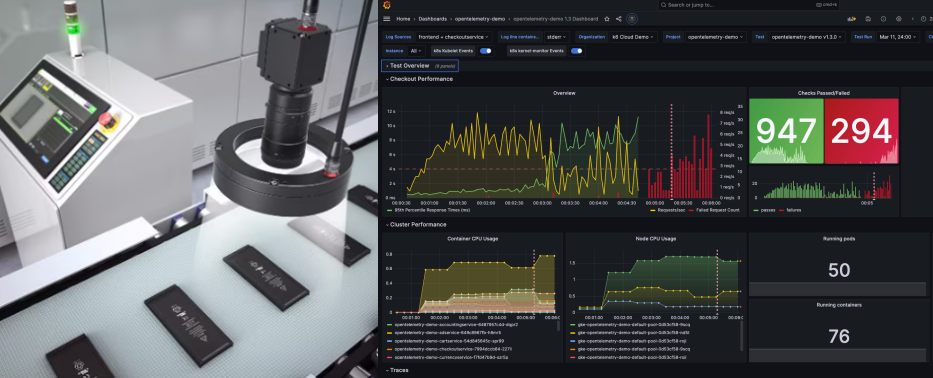
The camera system can operate independently or communicate with your existing control systems. If the inspection is part of a comprehensive production line, procedures and product parameters are configured via the master system. Modern technological processes cannot function without the long-term recording and evaluation of quality data and product parameters. We are also capable of designing and implementing electronic and mechanical camera peripherals as well as entire production lines.
We provide comprehensive services to ensure 100% reliability of camera inspections. When a product or production parameters change, we fine-tune the inspection settings and procedures. This ensures that your equipment remains up-to-date and ready for flexible production.
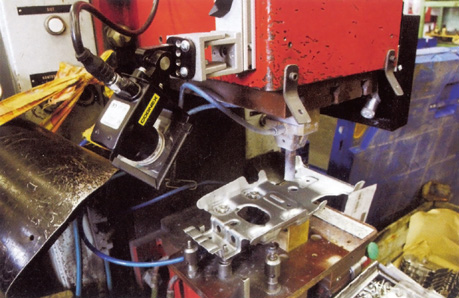
We designed, installed, and commissioned an optical inspection system to check for the presence of welded nuts and bolts on the “G handbrake lever” part on two spot welding machines. The new system replaced the previously used visual inspection by an operator, which in the past led to errors that were only detected at the customer’s site abroad. The failure of this inspection resulted in a costly 100% re-inspection of the entire production batch at the customer’s site.
The new system consists of an intelligent optical sensor, an external illuminator, a diffuse sensor, and a control panel. The machine performs spot welding on two screws in two working positions. The inspection is initiated simultaneously with the start of the spot welding operation. While the spot welder’s tip moves down and spot-welds the inserted screw, an analysis of the captured scene is performed. The part is sequentially inspected for the presence and correct orientation of four nuts welded in the previous operation and two spot-welded screws. At the same time, the correct sequence of operations is also monitored. If a missing nut or screw is detected, or if the sequence of operations is incorrect, the operator is alerted by audible and visual signals. Given the variable lighting conditions at the inspection site, a suitable lighting system for the inspected parts was designed, implemented using special LED spotlights.
This involves replacing the old, non-functional DVT Series 700 camera system. This system has been replaced with a Cognex 4G7 smart sensor.
This example illustrates a significant advancement in the field of camera systems. Whereas a seemingly simple optical inspection task once required the use of a highly sophisticated and expensive optical inspection system, that system has now been replaced by an intelligent sensor at a fraction of the cost. Intelligent sensors are the simplest camera systems equipped with basic optical inspection tools.
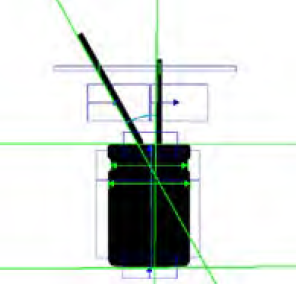
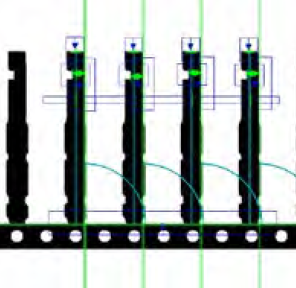
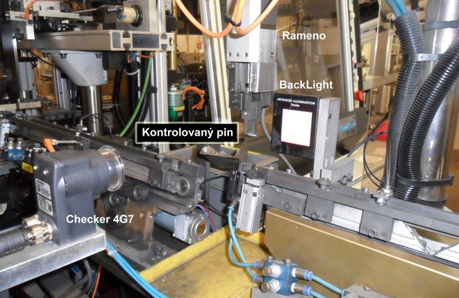
The task involves checking the correct orientation and type of pin. The machine processes two types of pins of different lengths. Two tasks have been created in the checker for each type of pin. When production changes, the checker automatically switches to the specified pin type. The cores are transported from the vibrating hopper to the inspection station via a belt conveyor. A three-axis arm picks up the pin from the conveyor and positions it in front of the checker. If the core is the correct type and correctly oriented, the arm places it on the next conveyor. If the core is incorrectly oriented, the arm rotates it into the correct position. If the core is the wrong type, the arm places it on a chute into the bin for defective pins.
Please don’t hesitate to contact us to find out how we can help optimize your manufacturing processes using state-of-the-art machine vision technology. We look forward to working with you!